|
Smaller crowds challenge Putin after Russia poll |
|
MOSCOW (Reuters) - Thousands of people chanting "Time for change" challenged Vladimir Putin's presidential election victory on Saturday but far fewer turned out to protest against the Russian leader than in previous weeks. People who demonstrated in bright sunshine in central Moscow waved flags, balloons and banners and wore white ribbons, the symbol of protests that began three months ago. Echoing chants from previous rallies, they shouted "Russia without Putin". "The road will be long and hard, it will be no quick struggle, but we will do it all. Russia will be free - Russia demands change!" liberal leader Grigory Yavlinsky told the crowd. But organizers put the crowd at 25,000, about a quarter of the size of the last protest before the March 4 poll gave Putin a six-year third term as president. Police estimated the crowd at 10,000 and independent witnesses put it at under 20,000.
Even though international vote monitors say the election was skewed in his favor, opposition leaders have been forced by the margin of victory to acknowledge that Putin was the winner. Officials results showed the prime minister and former KGB spy won almost 64 percent of votes and put the runner-up, Communist Gennady Zyuganov, on less than 18 percent. The opposition is struggling to find a way to maintain pressure on Putin and mount a sustained challenge to the man they say has stunted Russia's political and economic development after 12 years rule as president or prime minister. Some are defiant. Sergei Udaltsov, a far-left leader, called for 1 million people to march on May 1, a national holiday. "Only the street can change the authorities. Only the masses. We have no other option. That's why we'll be fighting, going onto the streets - until we overthrow them," he said. But organizers did not agree on a date for the next protest and many said the opposition has to be patient over its demands for a more open political system and greater democracy. "If this system took 15 or so years to be created, we need a few years - three, four, five - to dismantle it," Yavlinsky said.
MOOD CHANGE
|
|
Read more...
|
|
Face it, are you safe on Facebook? |
|
KATHMANDU, AUG 24 - Five students of Chitwan Medical College, Bharatpur, received messages in their Facebook inbox some six months ago. The message delivered from an account impersonating Facebook Administration asked them to submit email IDs and passwords so that their account security could be upgraded. By the time they realised that they had been taken for a ride, most of them had their Facebook statuses updated—with profane content.
“We happily submitted our vital information on the link, believing it to be a part of Facebook’s effort to upgrade our security. However, we were fooled beyond our imagination,” said Akriti Sharma, now a second year medical student at the college. More and more Nepali users of password-security based web applications these days have been reporting infringement on their web world.
Cases of such account infringement are, however, not single dimensional. The most common are phishing scams, like the one the students of CMC College experienced where one is sent a fake link of the Log In page of a website or where one is asked to submit vital information.
Moreover, there are key-logging applications which track every key that one presses on the keyboard. People, who are using Facebook from unsecure stations, are prone to disaster if the devices they are using have such applications installed.
|
|
Read more...
|
|
|
University should be recognized as a pure educational place - Sharma |
|
By SAN Reporters
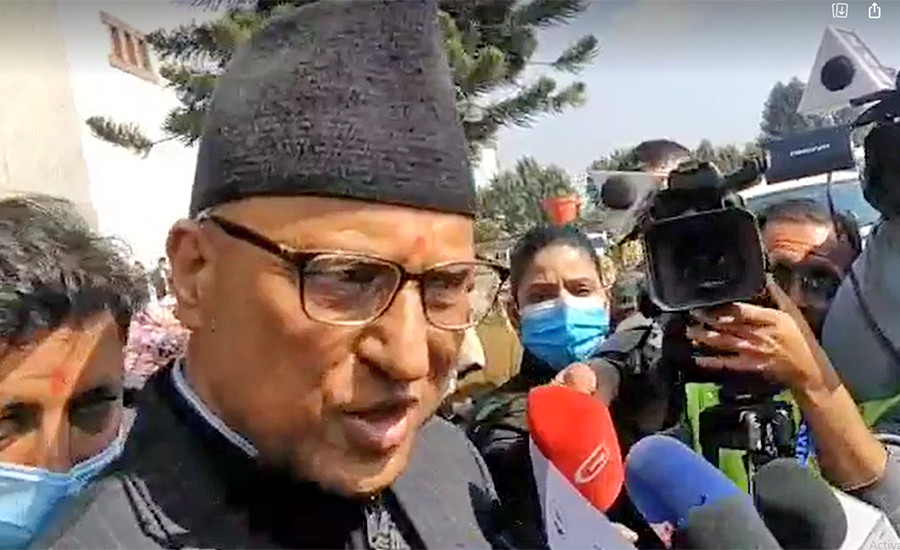
Interview with Hon. Dina Nath Sharma
Born on 4th Shrawan, 2003 B.S. at Humlachaur VDC in Banglung District, Mr. Dina Nath Sharma is one of the prominent political figures of Nepal. He is a central committee member of CPN Moist too. Mr. Sharma is the education minister in the present government led by his party. He has spent 21 years of his life in teaching profession.
How do you view the history and development of Nepal's educational policies? The entire history of Nepal's educational policies may be classified into three broad segments corresponding to three major historical changes. They are i. the policies before the Panchayat era, ii. the Panchayat Education (New Education Policy), and iii. Education Policy with Open Economy.
The introduction of education policy based on privatization and open market policy after the change of 2048 B.S. is in practice until today. The policy, however, is not going smoothly in the interest of special socio-economic life of our nation. The education system, especially higher education, is facing chaos everywhere. Misgivings are rife as to the question of equilibrium between open marketization of education and state's commitment for providing education as basic right. This also entails the question of quality in education. After the revolution of 2046, as after each major change, the education policy of Nepal was only slightly altered. Essence of previous so-called New Education Policy was left just so. Thus, the existing education policy is not able to catch up with the changed context of the 21st century, and cannot respond sufficiently to international global market.
Today's education should represent the spirit of our time. Therefore, a new policy should be developed for the secondary as well as higher education levels. Although many universities, colleges and schools have been opened, they all seem to be engaged in money-making business, rather than providing service to the people. As far as I am concerned, very few of those who are involved in this profession are worried about the future of the country, equity and quality of education, change of society through education and many such issues. Very few of them think with education in priority. Even so-called educationists and experts are found to be taking education in terms of business potentiality. There is dearth of people who wish to involve selflessly and honestly in the field.
In Nepal, most political parties have contributed to the culture of politicizing the business of policy makers in education. They have monopolized the system in such as a way that every working staff is bound to work in the interest of the party in power. This practice, in turn, obliges even the responsible people to stick to the periphery of their party. There should be revolution in Political leaders as well as intellectuals in order to be able to work exclusively for the overall revolution of education in Nepal. Nation should be in priority, not the parties and their vested interests. The entire system of education and conventional thought on education needs radical restructuring.
What are the plans which being implemented immediately? The first immediate plan is to make the temporary teachers permanent. The second phase is to implement Basic Education (from class one to eight), Secondary education (from class nine to twelve) and higher education (university education) for the proper management of education. Many types of teachers have been working in the government, community and private institutions. Efforts are being made to address their problems. A proposal demanding urgent change in the education policy of 2028 has been already sent for endorsement. Since the time the chairman of Education Commission was appointed, about thirty four thousand teachers from all the seventy five districts have been promoted.
|
|
Read more...
|
|